
How Can France Turn
Fusion Excellence into
Industrial Leadership?
Experts Answer
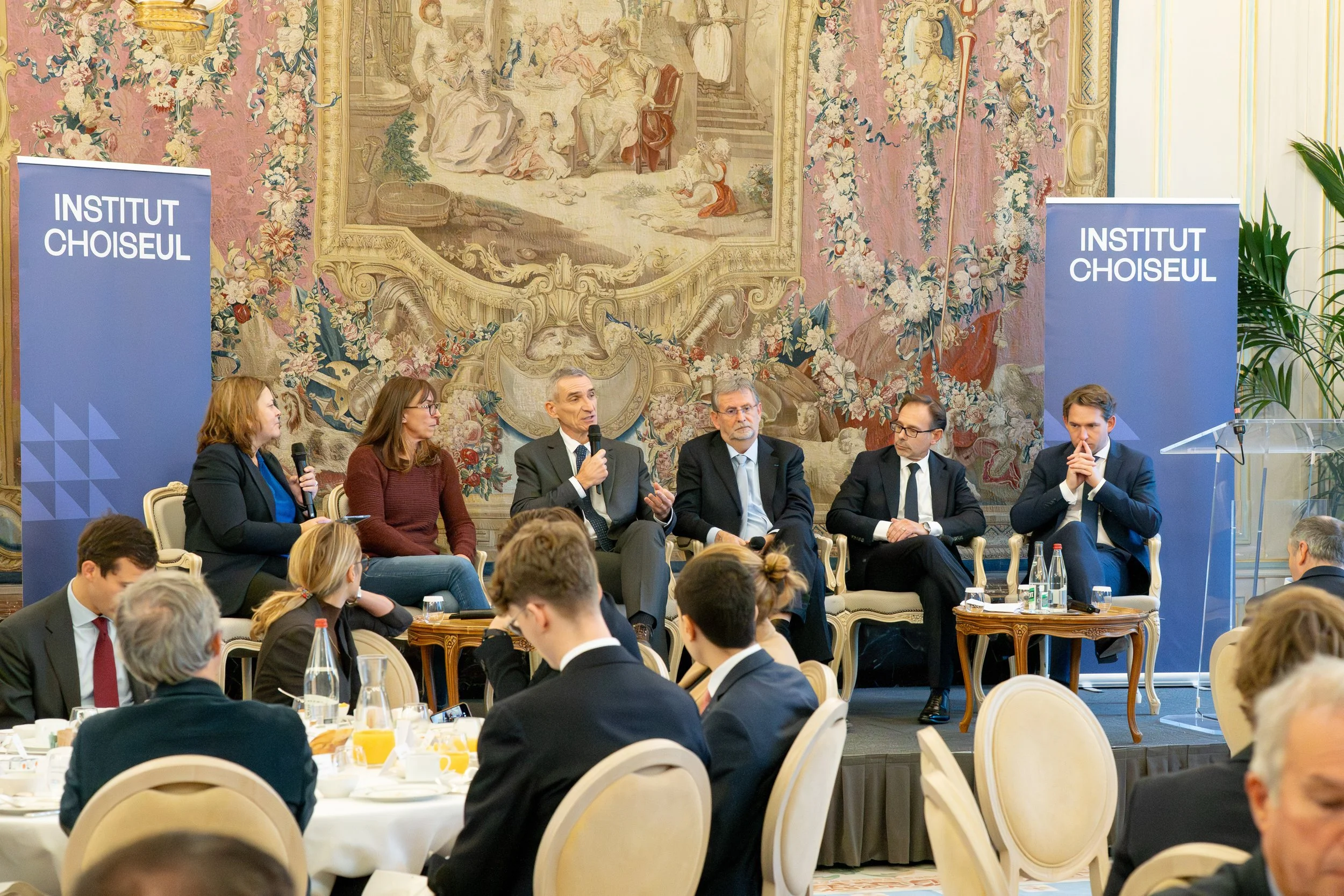
Following the release of the French Fusion Strategy, experts gathered in Paris to discuss how France can accelerate industrialization, strengthen strategic technologies such as High-Temperature Superconductors (HTS), and secure a leading role in the global fusion economy.
November 25, 2026 - How can France transform its fusion expertise into industrial leadership?
That was the central question discussed this week at an event organized in Paris by the think tank Institut Choiseul, a week after the release of the French Fusion Strategy.
The discussion brought together leading public- and private-sector experts, including our CEO Sam Guilaume,
alongside Christel Fenzi (PhD), Alain Becoulet, Conrad Bellehumeur and Raphaël Schellenberger, in a panel
moderated by Nathalie Croisé.
During the debate, Renaissance Fusion CEO stressed that the next competitive frontier for fusion is
industrialization : "The newly published French fusion strategy is a first step forward. It rightly recognizes that
fusion's next challenge is no longer scientific alone. It is industrial. France must seize the opportunity to secure a
strategic position in the global fusion value chain, including in technologies that are currently dominated by a
handful of foreign players."
The Institut Choiseul also presented its report ‘ Nuclear Fusion: Toward a French Industrial Strategy’ ,which
identifies five priorities for building a competitive French fusion industry:
To further develop and implement the national strategy by aligning scientific and industrial objectives;
Public-private partnerships that treat fusion companies as full-fledged industrial developers rather than merely suppliers to public research;
A proportionate regulatory framework, consistent with European and international standards;
Structured partnerships between fusion stakeholders and energy industry players for the deployment of demonstration plants followed by commercial power stations;
Strengthening France’s influence within European funding bodies and international standardisation bodies.
A case in point, raised during the debate, is High-Temperature Superconductors (HTS), which are emerging as a critical bottleneck for the development of future fusion power plants. To address this challenge, the French strategy clearly identifies the rebuilding of domestic superconducting magnet capabilities as a strategic objective.
Renaissance Fusion is actively contributing to this goal through its 𝘄𝗶𝗱𝗲 𝗛𝗧𝗦 𝘁𝗮𝗽𝗲 manufacturing project and innovative, laser-engraved magnet concept, which received the SOFT prize in September.
The next step towards concrete and coordinated action for fusion commercialization is the publication of the 𝗘𝗨 𝗙𝘂𝘀𝗶𝗼𝗻 𝗦𝘁𝗿𝗮𝘁𝗲𝗴𝘆, expected on December 2.
(credit photo: Bogdan-Mihai Dragot)
Want to know more? Reach out: media@renfusion.eu